Madrid Excursions to El Escorial
(Madrid, Spain)
Alcalá de Henares Information
Aranjuez Information
Ávila Information
Chinchón Information
El Escorial Information
El Pardo Information
Segovia Information
Toledo Information
El Escorial
This town is roughly 1,038 metres / 3,460 feet above sea level and as well as being a popular escape from Madrid by the capital's residents during the hotter months of the year, it is famous for the Palacio de San Lorenzo de El Escorial (Palace of St. Lawrence of El Escorial) complex.
Facts about El Escorial
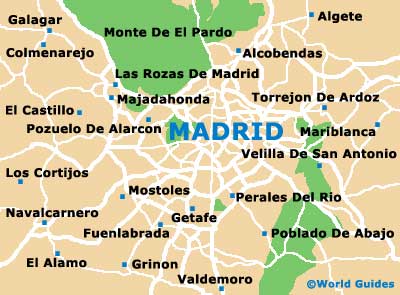
- Location: approximately 50 km / 31 miles south-east of Madrid
- Tourist information: Calle de Grimaldi 2, Tel: +34 91 890 53 13
Open hours: Monday to Thursday - 10:00 to 18:00, Friday to Sunday - 10:00 to 19:00
Places of Interest
Palacio de San Lorenzo de El Escorial (Palace of St. Lawrence of El Escorial)
This grey granite complex was ordered by Felipe II, to pay homage to St. Lawrence and to celebrate victory over the French at the Battle of St. Quentin, in France, on the 10th August 1557. The original plans for this palace are accredited to the architect Juan Baustista de Toledo; however, four years into the project Baustista died and Juan de Herrera became his successor. Herrera is considered to be the best architect of this era with the Royal Palace of Aranjuez and Toledo's Alcázar amongst his works. Construction on the Doric-style complex began in 1563 with completion occurring only 21 years later in 1584. Spain's largest building measures 205 metres / 672 feet from north to south and 160 metres / 525 feet east to west, the corner towers are 55 metres / 180 feet high whilst the dome-shaped roof of the church overshadows these at 91 metres / 302 feet.
The palace has 300 rooms, 86 staircases, 2,600 windows, over 1,200 doors, 15 cloisters, 16 courtyards and 88 fountains. Impressive though these statistics are, they do not give justice to a building that is often referred to by many modern-day Spaniards as the eighth wonder of the world. Areas of the complex still in use today, include a college and monastery. The monastery is in fact one of the complex's points of interest along with the biblioteca (library), which houses 40,000 treasured volumes and the panteones (mausoleums). These areas, plus the museums, hold various primary works of art of the royal Habsburg collections.
The Panteón de Reyes (Pantheon of the Kings) has the distinction of containing the remains of all the Habsburg and Bourbon kings who ruled Spain, excluding Felipe V who is buried at La Granja de San Ildefonso and Fernando VI who was laid to rest in Madrid.
Open hours: Tuesday to Sunday - 10:00 to 18:00 (October to March until 17:00)
Admission: charge, reduction for students, basilica free. Price includes guided tour of panteones and the Palacio de los Austrias. Last admission one hour before closing time
Valle de los Caidos (Valley of the Fallen)
Address: located approximately 58 km / 36 miles north-west of Madrid, 8 km / 5 miles north of El Escorial
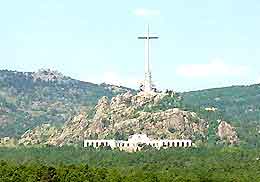
Generalísimo Francisco Franco ordered a monument to be constructed in Spain's forested valley to commemorate those killed on both sides of the Civil War of 1936. The result was the Santa Cruz del Valle de los Caídos (Holy Cross of the Valley of the Fallen) marking a basilica carved out of the granite hill of Nava.
Places of Interest
Santa Cruz del Valle de los Caídos (Holy Cross of the Valley of the Fallen)
Built in the 1940's by Republican political prisoners, the Iglesia de los Caídos (Church of the Fallen) was to later house the body of General Franco when he was buried here in 1975. The church was dug 250 metres / 820 feet into the rock and a stone cross hoisted to denote its position. The cross is 150 metres / 492 feet in height, 42 metres / 140 feet wide and can be visited via a funicular lift.
Open hours: Tuesday to Sunday - 10:00 to 18:00, funicular runs between 10:30 to 14:10 and 16:00 to 17:40
Admission: site - charge


 - Google+